

Moreno Valley's Transit Evolution: From Electric Streetcars to Modern Mobility |
Enhancing Urban Connectivity Through Infrastructure Innovation |
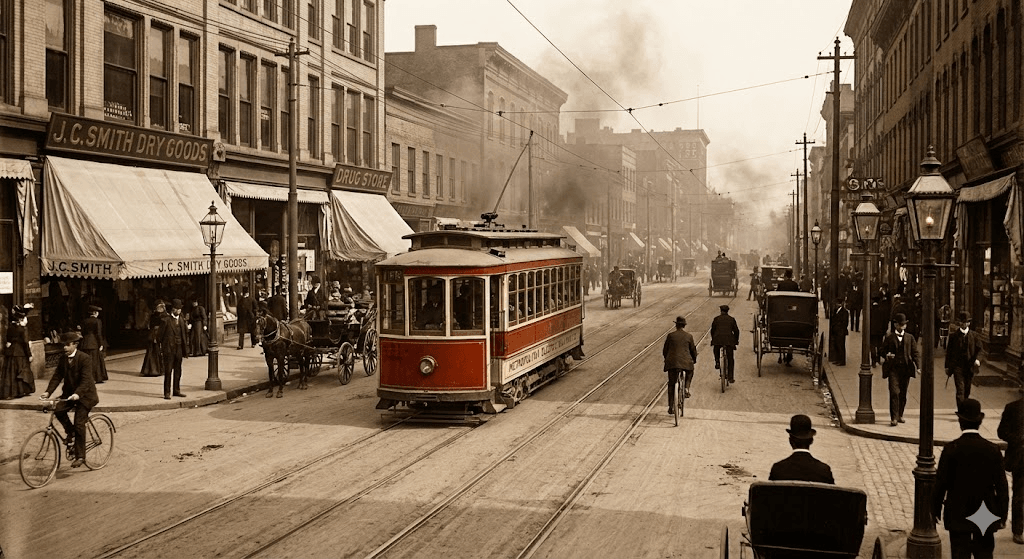
In 1888, the advent of the electric streetcar revolutionized urban mobility, enabling cities to expand beyond compact centers without sacrificing connectivity.
This innovation underscored that urban mobility isn't solely about speed; it's fundamentally about access.
Infrastructure determines who can engage in daily life and how seamlessly they can do so.
The electric streetcar offered consistent routes and dependable schedules, allowing people to plan their days with confidence.
This reliability fostered economic growth and strengthened social connections.
Moreno Valley's development has long depended on systems that connect residents to opportunities—be it through roads, transit corridors, or public services designed to minimize obstacles.
The streetcar served as an early model of this approach.
What made the 1888 innovation powerful was its simplicity: electricity replaced unpredictability, democratizing movement.
Cities grew smarter by designing for flow rather than congestion.
Today, Moreno Valley embodies that same forward-thinking mindset, recognizing that accessible infrastructure is foundational, not optional.
Recent enhancements to the Moreno Valley/March Field Metrolink Station exemplify this commitment.
Completed in July 2025, the $38 million project added a second train platform and extended the existing one to accommodate Metrolink's standard six-car trains.
These upgrades aim to improve service reliability and frequency on the 91/Perris Valley Line, offering residents efficient alternatives to driving and alleviating congestion on I-215.
Additionally, the city has modernized nearly 200 traffic signals, integrating cutting-edge technology to enhance traffic flow and road safety.
With grant funding from the Local Highway Safety Improvement Program, over half of the existing signals were replaced with modernized reflective signals in 2025, improving visibility at 89 intersections.
Furthermore, Moreno Valley has expanded its fleet of zero-emission vehicles, adding six new Ford E-Transit vans in April 2024.
This brings the total to 11 electric vehicles, reducing emissions and promoting a cleaner environment.
The electric streetcar reminds us that when mobility improves, cities don't just expand—they integrate.
Moreno Valley's ongoing investments in accessible infrastructure continue to honor this legacy, ensuring that all residents can participate fully in the city's growth and vibrancy. |
0 Comments
Join the conversation
Be the first to comment
Share your thoughts above.